

- Home
- Destination
- Dashoguz
- Konye-Urgench
- Mausoleum of Sultan Tekesh
Explore The Mausoleum of Sultan Tekesh With Us
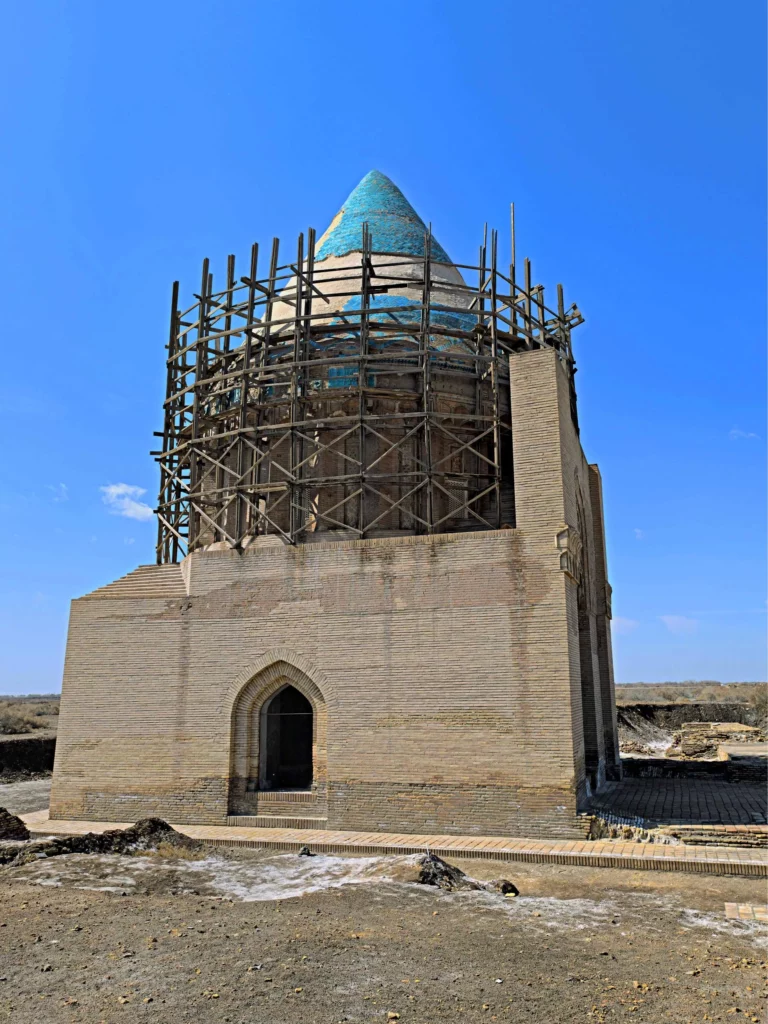
The Mausoleum of Sultan Tekesh – A Desert Beacon of Power and Paradox
Amid the sunbaked ruins of Kunya-Urgench, a UNESCO World Heritage Site in Turkmenistan, the Mausoleum of Sultan Tekesh (also known as Sherepbaba or Gyok-Gumbez) stands as a haunting relic of the Khorezmshah Empire’s zenith. Built in the late 12th century, this pre-Mongol monument—once a 30-meter-tall desert beacon—offers a glimpse into the ambition and brutality of one of Central Asia’s most formidable rulers.
The Tyrant and His Tomb
Sultan Ala ad-Din Tekesh (r. 1172–1200) was a figure of stark contrasts: a unifier of empires and a parricide. He forged a realm stretching from the Aral Sea to the Persian Gulf and Pamir to the Iranian Plateau, yet his rise was marred by treachery. To seize power, he allied with former foes, the Kara-Khitans, and later ordered his mother’s assassination. His mausoleum, part of a royal necropolis shared with the Il-Arslan Mausoleum, reflects this duality—grand in scale, yet shadowed by infamy.
Architectural Grandeur
Though now a skeletal ruin, the mausoleum’s original design was a marvel of its age:
Beacon in the Desert:
Its 30-meter height (comparable to Sultan Sanjar’s Mausoleum in Merv) served as a landmark for Silk Road travelers, signaling refuge in the arid expanse.
Symbol of Authority:
The conical brick dome (Gyok-Gumbez likely meaning “Blue Dome”) and massive walls embodied imperial power, towering over the city’s skyline.
Pre-Mongol Craftsmanship:
While stripped of its former glory, remnants of intricate brickwork and geometric patterns hint at its artistic legacy.
Legacy and Decay
Time and Mongol invasions have reduced the structure to a fractured shell, yet its imposing silhouette still captivates. The site’s local moniker, *Sherepbaba* (“Dragon Father”), echoes legends of Tekesh’s ruthless charisma. Unlike the ornate Kutlug-Timur Minaret nearby, this mausoleum’s raw, skeletal form evokes the transience of power.
Why Visit?
Historical Gravity:
Walk the necropolis of Khorezm’s rulers, where politics and piety collided.
Archural Contrast:
Compare its austere remains with the Il-Arslan Mausoleum’s terracotta splendor.
Mythic Aura:
Reflect on the paradox of a ruler who shaped empires yet succumbed to moral decay.
The Mausoleum of Sultan Tekesh is more than a tomb—it’s a metaphor for ambition’s fragility. For history enthusiasts, it’s a poignant stop in Kunya-Urgench’s archaeological tapestry, best visited at dusk when the setting sun casts long shadows over its ruins. Pair it with the Kutlug-Timur Minaret and Kyrk Molla hill for a full immersion into the rise and fall of Khorezm.
Travel Tip:
Bring water and a hat—the site offers little shade—and let your imagination rebuild the dome that once guided caravans through the desert. Here, the past whispers warnings as loudly as it sings of splendor.
OUR VISION
At “Stan Holidays”, we envision a world where travelers can discover the beauty and diversity of Central Asia while fostering mutual understanding and respect between cultures. We strive to be the leading travel agency in Turkmenistan, known for our exceptional service, deep local knowledge, and dedication to creating meaningful travel experiences.
Join us at “Stan Holidays” and let us take you on a journey through Turkmen wonders. Whether it’s your first visit or a return trip, we promise an adventure that will stay with you forever.